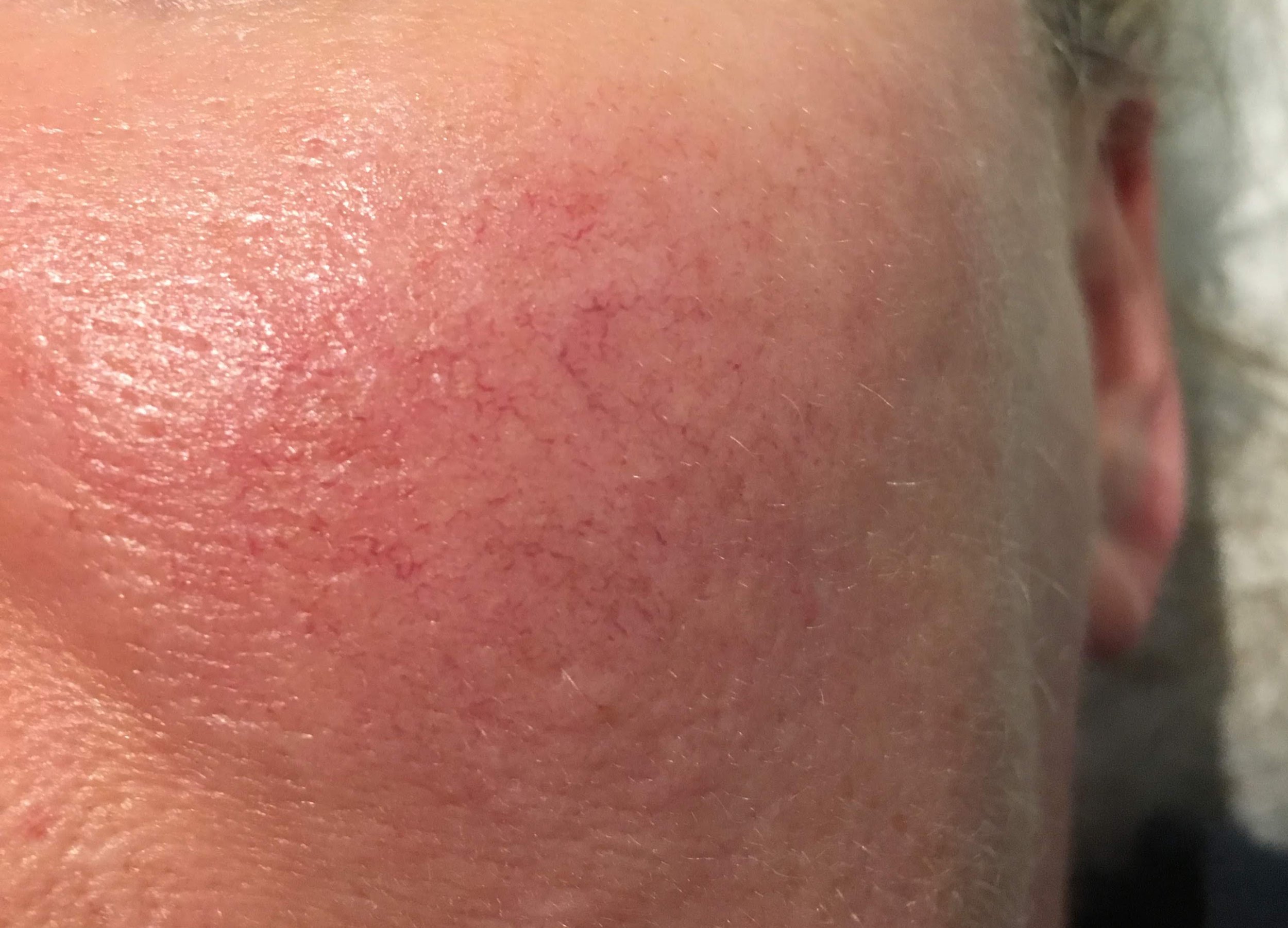
Thread veins are incredibly common, particularly on the face, and although they are generally harmless, many people find that they become more noticeable with age.
I have been treating facial thread veins using Advanced Electrolysis for nearly 40 years, so in this article I wanted to explain what they actually are, why they develop and what you can realistically expect from treatment.
What are thread veins?
Thread veins are tiny, permanently dilated blood vessels that sit close to the surface of the skin.
Medically known as telangiectasia, they are also often referred to as broken capillaries, broken veins or red veins.
The term “broken capillaries” is actually a little misleading because the vessels are not necessarily broken. They have become dilated and remain visible through the skin.
They are usually red, although some vessels can appear darker, blue or purple depending on their size, depth and the type of blood vessel involved.
Where do thread veins appear?
Thread veins can appear anywhere on the body, but they are particularly common on exposed areas of the skin.
On the face, I frequently see them around the:
nose
cheeks
chin
They can also appear on the neck and chest.
Thread or spider veins are also common on the legs, although these can be slightly different in nature and may be associated with deeper veins or problems such as chronic venous insufficiency or varicose veins.
What causes facial thread veins?
There isn't always one obvious cause.
Often it is a combination of genetics, ageing, environmental exposure and other factors.
Some of the most common include:
Genetics – some people simply have a greater tendency to develop visible facial vessels.
Ageing – changes within the skin and blood vessels can make thread veins become more visible over time.
Sun and UV exposure – long-term sun damage is a very common contributor to facial telangiectasia.
Hormonal changes – pregnancy and other hormonal influences can play a part.
Rosacea – visible facial blood vessels are commonly associated with rosacea.
Temperature extremes and environmental exposure – repeated exposure to heat, cold and harsh weather may contribute.
Skin trauma – scarring, repeated friction or aggressive treatment of the skin can sometimes lead to visible vessels.
Radiation treatment – telangiectasia can occasionally develop following radiation to the skin.
Certain medications – some medicines, particularly prolonged use of topical or systemic corticosteroids and some vasodilators, can contribute.
Some underlying health conditions – telangiectasia can occasionally be associated with conditions including liver disease and certain connective tissue disorders.
Things such as alcohol, spicy foods and heat can also make facial flushing and redness temporarily more noticeable, particularly in people with rosacea, although they are not necessarily the underlying cause of the thread veins themselves.
This is one of the reasons why I always carry out a consultation before treatment rather than simply treating every visible red vessel.
How can thread veins be treated?
There are a number of treatments available for facial thread veins, including vascular laser, IPL and electrosurgical techniques.
Having worked with Advanced Electrolysis for nearly 40 years, it is a treatment I use regularly for suitable small facial thread veins.
Using a very fine, sterile, single-use probe, controlled heat is applied precisely along the visible capillary.
The high-frequency current causes the blood within the vessel to coagulate. During the healing process, blood is temporarily redirected through surrounding vessels. As the treated area heals, a new, smaller channel can form through the vessel. This process is known as recanalisation.
Because the resulting vessel is smaller, it becomes much less visible through the skin.
Small sections are treated at intervals rather than repeatedly treating the whole area at once. This helps minimise unnecessary trauma to the surrounding skin.
The heat coagulates the tiny vessel so that it no longer remains as visibly red. Over the following days and weeks, the treated vessel gradually becomes less noticeable as the skin heals.
We deliberately avoid over-treating an area, which is why widespread thread veins may need to be treated gradually over more than one appointment.
What will my skin look like afterwards?
Some redness and slight localised swelling immediately after treatment are normal.
Over the following 24–48 hours, tiny crusts or pinprick scabs may develop. These are part of the normal healing process.
It is very important not to pick or scratch them. Removing them prematurely can increase the risk of infection, pigmentation changes or scarring.
I provide an appropriate aftercare product following treatment and give you individual instructions about looking after the area while it heals.
The tiny crusts will usually disappear naturally within approximately 5–10 days, although everyone heals at a slightly different rate.
I also advise using a high-protection broad-spectrum SPF 50 and being particularly careful about sun exposure while the skin is healing and for the weeks following treatment.
Can thread veins on the legs be treated with Advanced Electrolysis?
Advanced Electrolysis is particularly useful for suitable small thread veins on areas such as the face and upper chest.
Leg thread veins can be more complex.
They are often deeper and may be associated with underlying venous problems such as varicose veins or chronic venous insufficiency. In these circumstances, the underlying cause needs to be considered first and treatments such as sclerotherapy or vascular laser may be more appropriate.
An occasional small vessel caused by local trauma may be suitable for treatment, but I would always assess this individually.
Is thread vein treatment safe?
For a suitable thread vein, Advanced Electrolysis can be a very safe treatment when carried out by an appropriately trained and experienced practitioner.
However, no skin treatment is completely without risk.
Temporary redness, swelling and crusting are expected. Less commonly, pigmentation changes, infection or scarring can occur, particularly if an area is over-treated or aftercare advice is not followed.
It is also important that we know what we are treating.
If a skin lesion or visible vessel looks unusual, has changed, is bleeding without obvious reason or I am unsure of its nature, I will advise medical assessment rather than treating it cosmetically.
How many treatments will I need?
This varies enormously depending on the individual and the extent of the thread veins.
Treatments are normally short, often up to around 15 minutes, because we do not want to over-treat the skin.
If we are returning to the same area, I generally advise allowing around four weeks between treatments so the skin has time to heal fully.
At your consultation I will give you an idea of what I think may be required, although it is impossible to predict exactly how an individual person's vessels will respond.
Where there are numerous vessels close together, a course of treatment is often more appropriate than trying to treat everything in one session.
How well does Advanced Electrolysis work for thread veins?
I never guarantee 100% removal.
Realistically, around a 60–80% improvement in the appearance of suitable red thread veins can often be achieved.
Some vessels respond extremely well, while others may need additional treatment.
Can thread veins come back?
A successfully treated vessel may remain greatly reduced, but treatment cannot prevent new thread veins from developing in the future.
If you have a genetic tendency towards them, significant sun exposure, rosacea or another underlying cause, new vessels may gradually appear in the surrounding skin.
Good sun protection and managing any underlying triggers can therefore be an important part of helping to minimise further visible redness.
Considering facial thread vein treatment in Brighton?
Every new client starts with a consultation so that I can assess the area properly, make sure the treatment is suitable and explain exactly what you can expect.
I offer specialist Advanced Electrolysis and skin blemish removal at Turn Beautiful in central Brighton and have been treating skin blemishes and facial thread veins for nearly 40 years.
If you’re concerned about facial thread veins and would like to know whether Advanced Electrolysis could be suitable for you, you can book a skin blemish removal consultation with me at Turn Beautiful in central Brighton.